How to give your horse medication
As a rider, it's useful to be able to treat your horse yourself. This is especially true in urgent cases, when waiting for the vet can take time. So how do you give medication to your horse? That's what we cover in this article.
Giving an oral paste
Before giving the medication, check that the horse's mouth is clean and free of food. The full dose will only be absorbed if the product is administered correctly (as with a wormer). To do this, take hold of the horse's tongue at the bars (the gap behind the incisors where the bit sits when the horse is bridled) and hold it firmly to one side. You can then place the paste as far back on the tongue as possible without any risk of being bitten — the horse would bite its own tongue first. Next, take the syringe out before releasing the tongue, keeping the horse's head raised. The horse will then swallow by reflex, so the medication goes down without any product being lost.
Intramuscular injection
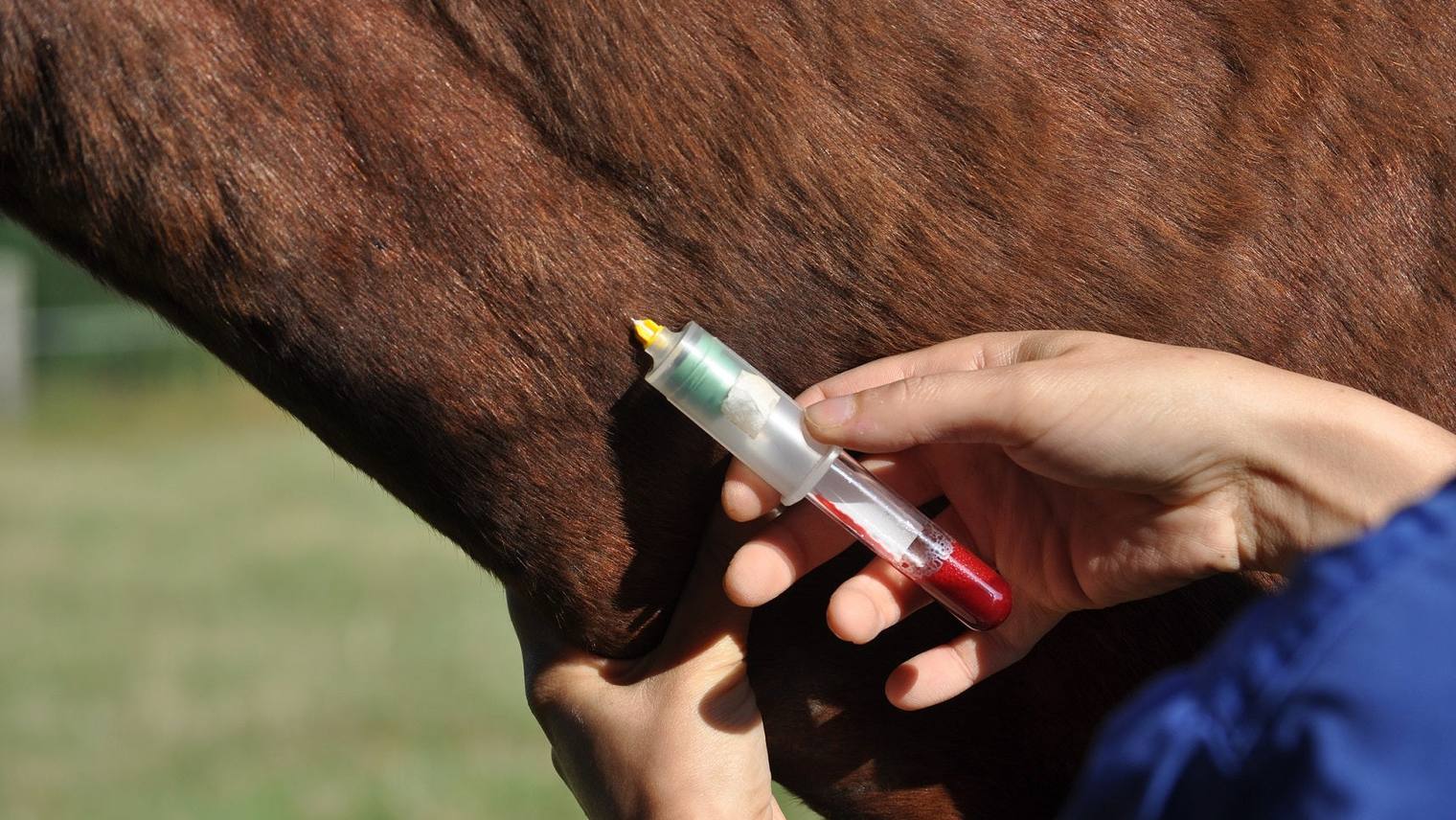
This is the most common injection route, with the neck being the preferred site, as an injection into the neck carries the least risk. The pharmacist should make sure the horse's owner is able to carry out an IM injection correctly. To that end, the anatomical limits of an IM injection in the neck need to be explained. Such an injection must be given within an area that lies a hand's width below the mane, a hand's width above the jugular groove and a hand's width in front of the point of the shoulder.
It's also worth remembering how important it is to change the exact spot within this area with each new injection, so that the product is spread out and swelling and inflammation at the injection site are kept to a minimum (picture an imaginary clock face within this area and inject at 12 o'clock on the first day, at 3 o'clock the next day, then at 6, at 9 and finally in the centre). If the horse is being injected twice a day (morning and evening), give one on the left side and the other on the right.
To avoid introducing outside germs into the deep muscle, you can use the "Z-track" technique. This involves pinching the skin and inserting the needle through the fold of skin right up to the hub before injecting, then withdrawing the needle and finally releasing the skin. Because the puncture in the skin is then offset from the one in the muscle, a natural, airtight barrier forms between the outside environment and the deep part of the muscle.
At La Sellerie Française you'll find the best products for looking after your horse properly.
Intravenous injection
This type of injection calls for good technique and care, so that the needle goes in at the right place and doesn't hit the carotid artery, which runs deep beneath the middle of the neck. The owner should inject into the upper third of the neck, that is, a hand's width below the mandible.
It's a good idea to press on the vein with your thumb while lifting the horse's head. This makes the vein stand out so you can see it clearly. The bevel of the needle should face the centre of the vein and the product should be injected gradually, using the "bubbling" method.
This technique involves drawing back a little blood to mix with the product and injecting it gradually, regularly mixing in a little more blood. Finally, it's also advisable to draw back blood one last time before taking the needle out of the vein. In addition, using a three-part syringe helps avoid accidental injections into the artery: if the needle enters an artery, arterial pressure pushes the plunger back, warning you before you inject. Venous pressure is very low, so when the needle is in the vein the plunger stays put when you let go of it.
Lastly, it's helpful to warm the product before injecting by holding the bottle under hot water when the ambient temperature is below 5 degrees.
From the workshops
Pieces related to this guide
Also worth reading