Shoeing your horses: what are the best practices?
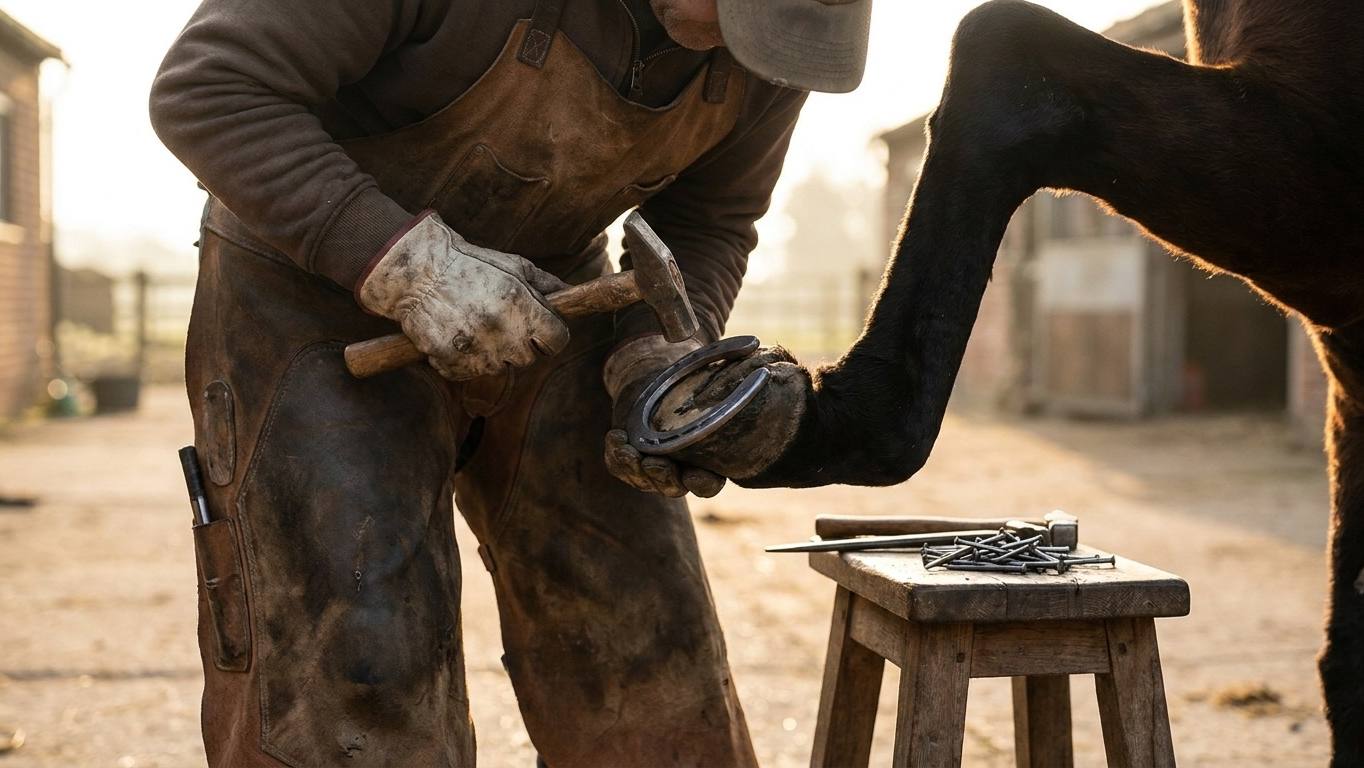
Farriery dates back to around 2000 BC, first with shoes attached using leather straps, then combined with nails that appeared in the time of the Gauls, and finally with clips and orthopaedic shoeing from the 16th and 17th centuries onwards.
Since then, shoes have changed a great deal, as have farriery techniques and our knowledge of horses. Today, shoes are used for sport, for leisure, to treat and correct conformation of the limbs, or simply to give comfort on varied ground and slow down wear of the hoof wall. There are several types of shoeing:
Conventional shoeing
Made of steel, it can be fitted hot or cold by the farrier. Shoes are made up of a toe, quarters at the toe, quarters, heels and several nail holes for the nails to pass through. Shoes come in several sizes so that they can be properly matched to your horse.
This type of shoeing is for leisure and sport horses, or horses with a condition requiring only a simple correction. The farrier can make a number of modifications (rolling the toe, bulbs, covered branches, pads, resin, etc.) so that the shoe is better suited and more comfortable.
Aluminium shoeing
Often used for sport horses, it was developed to lighten the limbs, reduce strain and give the horse more comfort, speed and performance. Aluminium shoes do, however, wear out faster than steel ones. They are fitted cold and the farrier can make the same modifications as on conventional shoeing.
Orthopaedic or physiotherapeutic shoeing
Whether therapeutic or preventive, its purpose is to retrain the movement of the foot in response to the ground. It is used to encourage breakover, reduce strain on tendons, ligaments and joints, relieve the foot and protect the sole. The shoes are aluminium and relieve many conditions such as arthritis, laminitis, navicular syndrome, and so on.
Shoes are changed every 6 to 8 weeks depending on the type of shoe and how quickly the hoof wall grows. It is best to allow 24 to 48 hours of rest, or to do only light work after the farrier's visit, so that the horse gets used to its new feet.
A few things to check after the farrier's visit
- Your horse can move freely, naturally, comfortably and without lameness
- Each foot stands square and is well aligned with the limb. The wall should be trimmed to a natural shape, in a straight line from the coronet to the bearing surface, with no flaring or excessive rasping
- The clenches are aligned, solid and flush with the surface of the hoof
- The shoe should be long enough to give good support to the heels so that the bearing surface is not reduced
If you notice anything wrong within 48 hours of the farrier's visit, call them back so they can put it right. You can also ask a vet to check and probe the foot if you are in any doubt.
Why shoe your horse?
For a horse with no underlying condition, the main purpose of shoeing is to prevent the foot wearing down quickly when the horse works regularly on varied ground. At top level, the shoe can also act as protection, supporting the foot and absorbing concussion (particularly on landing over a fence). For horses with a condition, there is a huge range of different orthopaedic shoes that will give them the best possible relief.
The drawbacks of shoeing
When a horse doesn't work on varied ground and has no underlying condition, shoeing is not recommended. These days we tend to shoe horses automatically, but it isn't all upside.
Because they are rigid, shoes prevent the feet from absorbing concussion and cause vibrations in the joints, tendons, ligaments and tissues in general.
What's more, since the frog is no longer in contact with the ground — and its role is to return blood towards the heart to ensure oxygenation and the elimination of toxins — these functions are limited by the shoes. In the long term this can cause problems in horses that were healthy to start with.
An alternative to steel shoes
There are now plastic shoes, which are light and designed to preserve the natural flexing of the hoof so that it can absorb concussion and allow proper stimulation of the frog.
Unlike steel, plastic grips the ground better: whether on wet ground or concrete, horses slip less. These shoes are glued on or fixed with the same nails as conventional shoeing. The downside is that they are more expensive and some farriers don't know how to fit them.
Keeping your horse barefoot
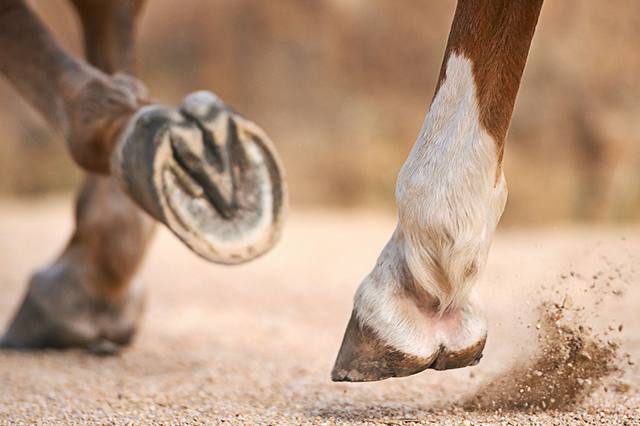
It is perfectly possible to keep a horse without shoes, whether for leisure or for sport. More and more owners are choosing this option. All horses can live and work without shoes, but some feet need more attention than others...
Some horses naturally have very good feet, with supple horn that grows easily and good conformation that allows the foot to wear evenly, while others have poorer feet.
In every case, it's important to keep an eye on the barefoot horse and to look after the foot by keeping it moisturised or using products such as oils and hoof ointments. A poorly maintained bare foot can cause discomfort, lameness, abscesses, and so on.
Taking your horse from shod to barefoot
If you want to make this transition, several precautions are needed. Talk to your farrier first, or get in touch with an equine podiatrist.
These specialists deal with feet, conformation, locomotion and trimming, in order to give horses appropriate care. They will guide and help you so that your horse copes as well as possible with going barefoot.
You need to watch how your horse reacts on different surfaces and call a professional if there is any discomfort or lameness. It is also a good idea to walk regularly on several types of ground so that the horse adapts to the change more quickly.
If your horse is uncomfortable, particularly on hard surfaces, hoof boots are available to protect the sole. You can use them when hacking out, but also on a daily basis.
From the workshops
Pieces related to this guide



Also worth reading