Working the horse's back the right way
Beyond carrying the rider's weight, the horse's back is a genuine "bridge" that transmits movement from the hindquarters to the forehand. It's thanks to the back that everything starts to work… or seizes up! Working in a way that respects your horse's back should therefore be every rider's priority. So how do you go about working in the right direction?
How does the horse's back work?
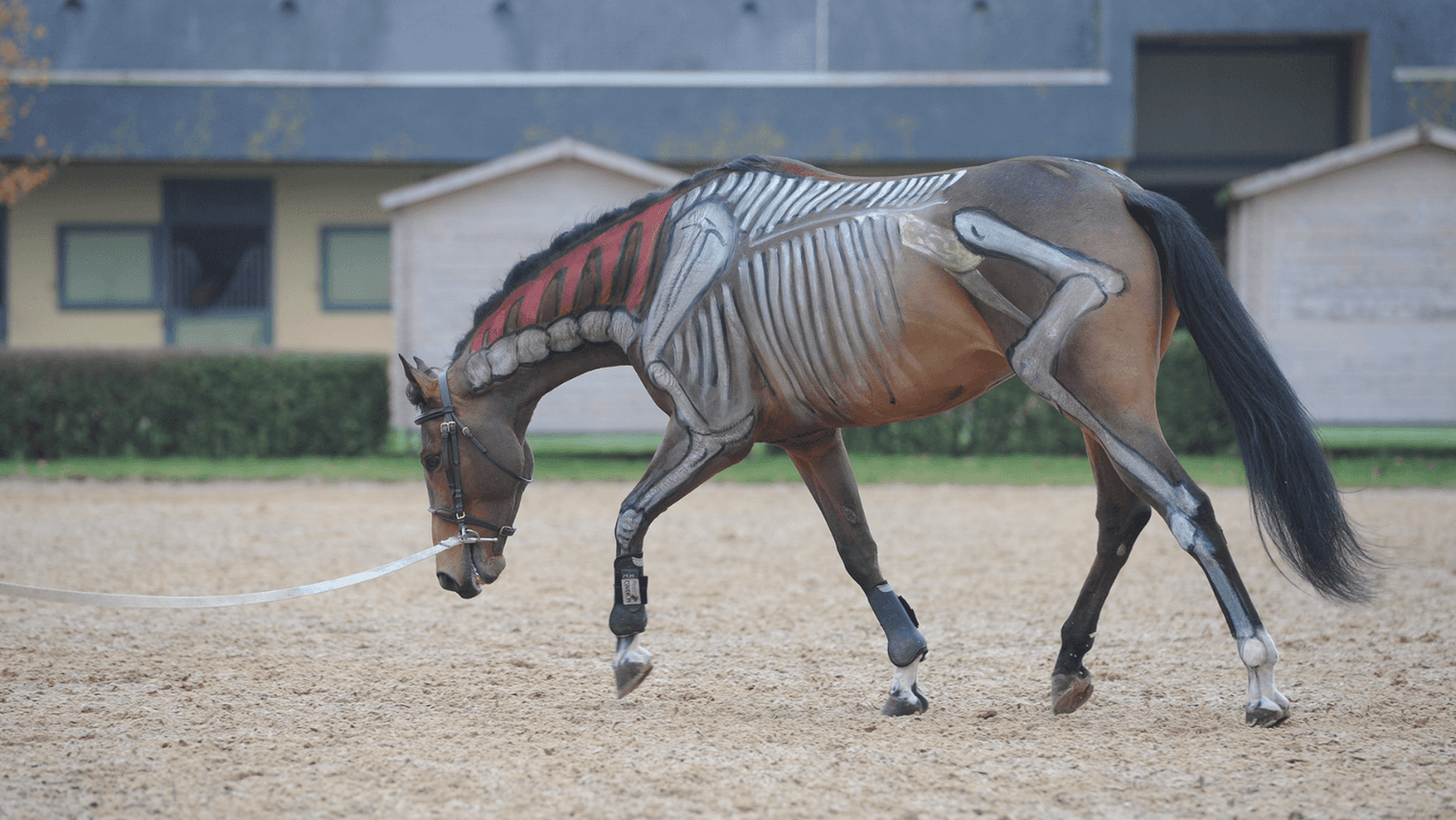
The horse's spine (rachis) is made up of: 7 cervical vertebrae, 18 dorsal/thoracic vertebrae, 6 lumbar vertebrae, 5 sacral vertebrae and 15 to 21 coccygeal/caudal vertebrae. All these vertebrae are linked together by intervertebral discs, joints, ligaments and muscles.
The first 9–10 thoracic vertebrae, which form the anatomical base of the withers, are distinctive in having very long spinous processes. That's an important anatomical feature to bear in mind when riding… In fact, the horse has probably suffered from back problems ever since man first climbed aboard.
The rider's entire weight is borne by the horse's spine. When a rider sits down on the back, you'll have noticed that a horse unused to being ridden (a youngster being backed) or used to being ridden badly tends to lift the neck while hollowing the back.
When the neck comes up, it slackens the nuchal and supraspinous ligaments that connect the spinous processes to one another (cervico-thoracic extension). As a result, the spinous processes converge and their tips (the spinous apophyses) rub against each other. Deformations of the vertebral axis are a source of weakness, pain and/or various problems.
Over time, if the horse continues to be worked this way, these deformations inevitably set off chain reactions that sometimes go well beyond back pathologies (certain navicular syndromes, problems with propulsion, digestive problems, etc.).
Stretching your horse's back without constant contact with the mouth
To work your horse's back in the right way, look for an outline close to the naturally relaxed posture the horse adopts at liberty. Focus on warming up the muscles and on obedience to the simplest, clearest aids.
Your horse will learn to move under your saddle without constant, untimely interference from your hands. Keep your reins taut, but with as little contact as possible, always holding your hands slightly above the mouth. Let your horse carry its head where it likes. For reins that won't upset your horse, take a look at La Sellerie Française.
To balance, turn, slow down or halt, act with your hands, then give completely on a loose rein to allow your horse to stretch as much as possible. As soon as your horse begins to stretch, give it a pat and show that you're pleased.
Once the stretching movements are well established, ask your horse to increase its speed (without losing balance) and its activity towards medium or even extended paces.
You'll achieve genuine tone through the topline — in other words, a horse that moves with its back. Practise this exercise first in walk and trot, then in canter, especially with hot horses.
At the end of this work (it's a matter of time) you'll have a horse that salivates and relaxes its jaw naturally, without any direct intervention from your hand. You will have freed your horse from the constraint of your hand. And you'll be moving in paces that have gained in regularity, amplitude and activity.
From the workshops
Pieces related to this guide



Also worth reading