Key figures and the importance of the equine industry in France

What are the key figures for riding in France? How important is this industry to the country's development? It's a question many riders and equestrian professionals ask themselves. There are plenty of angles to consider in any such assessment. In this article, we look at them.
Small businesses that create jobs
The French equine industry covers a wide variety of businesses, reflecting the diversity of its segments (racing, sport and leisure, working horses, meat production, etc.) and of the occupations within each segment. Two broad types of business exist side by side: those directly connected with horses, which breed, produce or use them, and related businesses that supply services to the former and to private individuals.
France had close to 32,000 businesses specialising in equine activities in 2022 (28,800 in the 2023 estimate), a third of them in breeding and 42% in sport and leisure, to which can be added the related businesses: farriers, vets, saddlers and equipment manufacturers, La Sellerie Française among them. IFCE, ÉCUS 2025 yearbook.
For farmers, the horse is also an opportunity to diversify through livery and services to owners. Together, these businesses generate an estimated turnover of 6.2 billion euros in 2023, and the industry supports 120,400 people in salaried and self-employed jobs, 54,300 of them directly linked to the breeding and use of horses.
Businesses in the racing segment generally post a higher turnover than those in other segments, while breeding operations show an average turnover lower than that of businesses involved in using horses.
These averages hide considerable variation: a village riding school and a yard with several dozen horses have neither the same turnover nor the same profitability, and some breeding operations, those with one or two mares, generate none at all.
One business in three is located in the Basse-Normandie, Pays de la Loire and Rhône-Alpes regions. More precisely, breeding activities are particularly well developed in the north-west, while the south-east is more of a horse-using region.
The horse as a player in land management
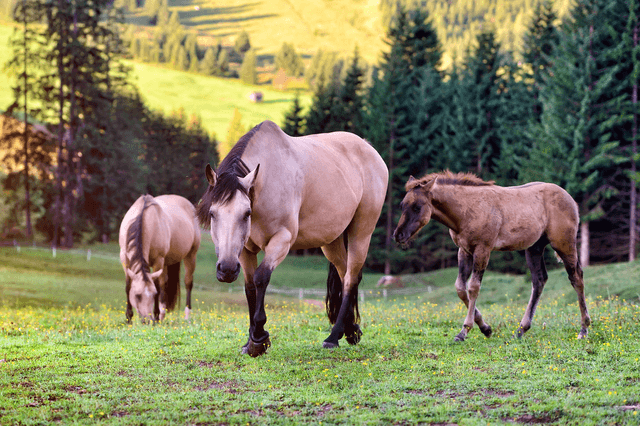
Horses can occupy a very wide range of environments, including difficult ground that is unproductive or has been abandoned by agriculture, and in particular by ruminant farming. They therefore help to maintain open land and preserve landscapes, especially at a time when numbers of other grazing animals are falling.
The equine population was estimated at 995,700 animals in 2024. It is holding up in areas where livestock farming is disappearing, and horses there make use of pasture and forage land that would otherwise have no purpose.
On top of this comes racing: 9.7 billion euros in horse racing bets recorded in 2024, 16% of them online, and a net contribution from the PMU to the industry of 837 million euros in the same year. ANJ, 2024 gambling market report; PMU, 2024 accounts.
Although this use of land competes with both agriculture and urban development in terms of property, it complements them in terms of how space is organised.
Horses in peri-urban areas make use of plots "in transition" that are no longer farmland and not yet built on. Beyond simply occupying space, the growth of activities such as equestrian tourism contributes to the vitality of these areas, both through the upkeep of bridleways and through job creation.
From the workshops
Pieces related to this guide

Also worth reading