The administration and regulation of horse race betting
Betting on horse races differs from other forms of gambling through its history, which is bound up with breeding and the improvement of the various equine breeds. The French racing system has been closely administered ever since the first organic law of 2 June 1891, which placed racing societies under the supervision of the Ministry of Agriculture and authorised those whose sole purpose was the improvement of the equine breed to take bets on their racecourses under the pari-mutuel model. In this article, you will find the essentials on the administration and regulation of horse race betting.
How does the opening up of online gambling to competition threaten the funding of horse racing?
From the outset, the State provided for levies on stakes, intended to fund charitable works on the one hand and breeding on the other. On top of this, the needs of reconstruction after the First World War gave rise to new levies earmarked for building hospitals, drinking water supply networks and modernising agricultural education. In 1930, the Parisian societies were authorised to take bets off-course; they then joined forces under the name PMU to manage and collect punters' stakes. The appetite for betting thus took precedence over the spectacle and the sport that drew the public to the racecourses.
The new levies on stakes were attached directly to the budgets of the ministries concerned and allocated to the various beneficiaries without passing through the national budget. By 1941 they already accounted for 12% of the bets recorded by the PMU. The levies reached 14.5% in 1956, allowing the creation of new funds for families (1956), for the development of sport (1980) and for the voluntary sector (1984). In order to retain control over the PMU, the State imposed a restructuring of the racing institution which led, in 1983, to the PMU becoming an economic interest grouping under State supervision, through which racing societies were obliged to go in order to organise off-course betting.
This monopoly allows the PMU to post a substantial turnover, among the highest in France across all sectors, and to contribute to the funding of the racing industry and the national economy. In 2024, 9.7 billion euros in horse race bets were recorded in France, a slight decline, including 1.6 billion online, the only segment that grew. IFCE, ÉCUS 2025 yearbook; ANJ, 2024 gambling market report. The PMU's net contribution to the industry came to 837 million euros that same year, paid to the racing societies and, through them, to breeders, trainers and racecourses. PMU, 2024 accounts.
However, the growth of online gambling, hard for the State to tax yet easily accessible to players, upset the balance of the system at a time when the European Union was also telling France that the monopoly held by the PMU (and by the Française des jeux, FDJ) was wholly at odds with the European aim of liberalising services and creating more competition in gambling. Other European countries were taken to task on the same grounds. Some chose to comply quickly by liberalising gambling, either completely, as in Italy and the United Kingdom, or more partially, as in Germany and Belgium, while others such as Portugal and Sweden defended the State monopoly on the grounds of tackling addiction, undertaking to keep stake levels in check.
Given the commercial efforts of the PMU and the FDJ to expand their customer base, it was difficult for France to argue for keeping the monopoly by pointing to good results in limiting addiction through sensible, responsible gambling 114. The various trade-offs led to the law of 12 May 2010, which opened the online gambling sector to competition. This law attempts to meet the European Union's demands while legalising the existence of private operators through licensing (7 horse race betting operators were licensed as soon as the law came into force). The law sets a maximum payout rate to players of 85%, a direct tax of 7.5% of stakes and an 8% levy on the sums wagered by punters, paid to the racing societies in respect of the public service mission of improving the equine species and promoting breeding that has been entrusted to them.
This last measure was not accepted at European level, and proceedings were opened against France concerning the compatibility of this levy with European law. Pending the outcome of that review, tax arrangements allow the racing societies to recover these amounts. The law opening up the market also allowed the municipalities where racecourses are located to receive, in proportion to the stakes actually wagered on those racecourses, a 15% share of the tax levy on horse race betting, subject to a ceiling of ten million euros in total and 700,000 euros per municipality. So far, the opening up to competition has not harmed the PMU, which stands as the leading betting site in France thanks to the success of its diversification, in a context where online betting accounts for only around 10% of stakes but is nonetheless growing strongly (+30% between 2010 and 2011).
The future funding of the racing industry is more uncertain. Indeed, the potential challenge to the payback to the racing societies threatens the current running of racing, since the levy represents 80% of their budget, a budget intended for organising races, maintaining training centres and, in particular, paying premiums and prize money to breeders and horse owners. Furthermore, part of the sum paid back to the racing societies helps fund structuring and innovative projects for the whole equine industry through the ÉPERON fund (nine million euros in 2010). This resource is therefore decisive, all the more so as there is no image right that would allow compensation for the use of races as a medium for betting.
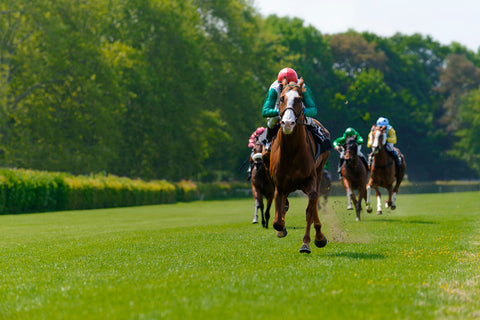
A regulatory framework still to be built between free competition, consumer protection and industry funding
The workings of the racing sector, whose economy rests largely on horse race betting, are thus caught up in the whirlwind of gambling policy, which concerns a wide variety of operators. Whether its future continues to rest on the historic system depends first and foremost on maintaining a return of stakes to the racing societies. While the 8% share appears "institutionalised" at French level, it remains uncertain at European level. The principle of a levy funding the organisation of racing and the payment of incentives can no doubt be justified as compatible with European law.
In the best case, France will manage to defend a return of 8% of stakes to fund the missions entrusted to the racing societies, possibly reduced if horse race betting continues to grow. Indeed, maintaining that percentage in the long term can surely only be defended by the need to keep the overall amount sufficient to guarantee the running of racing. Moreover, the broader question of regulating gambling is only in its early stages with the 2010 law. The many debates on the subject have the merit of reviving concerns about the social and health impacts of gambling.
The current drive to open up and stimulate competition may well, in the long run, come up against its public health consequences and lead to a return to a State monopoly on gambling, in a different form from the one that existed in the past, based on controlling stakes and on rules guaranteeing responsible gambling. In the long term, with the growth of powerful global operators, a complete liberalisation of gambling, including in "physical" outlets, cannot be ruled out, given the inability to control and tax these companies.
For racing, that would mean the complete disappearance of financial returns to the industry and the concentration of racing by private companies on a handful of racecourses bringing together technical, material and human resources. These possible developments must be put into perspective in relation to punters' interests. The return to the industry, even if it does become established over time, will only ensure its survival if stakes are high enough. Staging 18,000 races a year for 30,000 horses in training cannot be done without the contribution of punters or players, who will have to choose between the multitude of offerings put before them.
From the workshops
Pieces related to this guide


Also worth reading