Embroidery on leather: a saddler’s craft
A name on a browband, initials on a headcollar, a yard’s colours on a headpiece: personalisation is one of the pleasures of artisan saddlery, and embroidery on leather is its most demanding form. Unlike hot-stamping or engraving, it goes through the material. Every stitch is a hole in the leather, and a misplaced hole cannot be filled.
How a saddler embroiders leather
It all starts with the choice of leather. Leather that is too thin tears between the stitches; leather that is too thick or too dry breaks the needle and shows uneven stitches. Workshops embroider on vegetable-tanned leather, supple and of good thickness, often on a separate piece that is then stitched onto the browband or headcollar, which allows a fresh start without sacrificing the whole item.
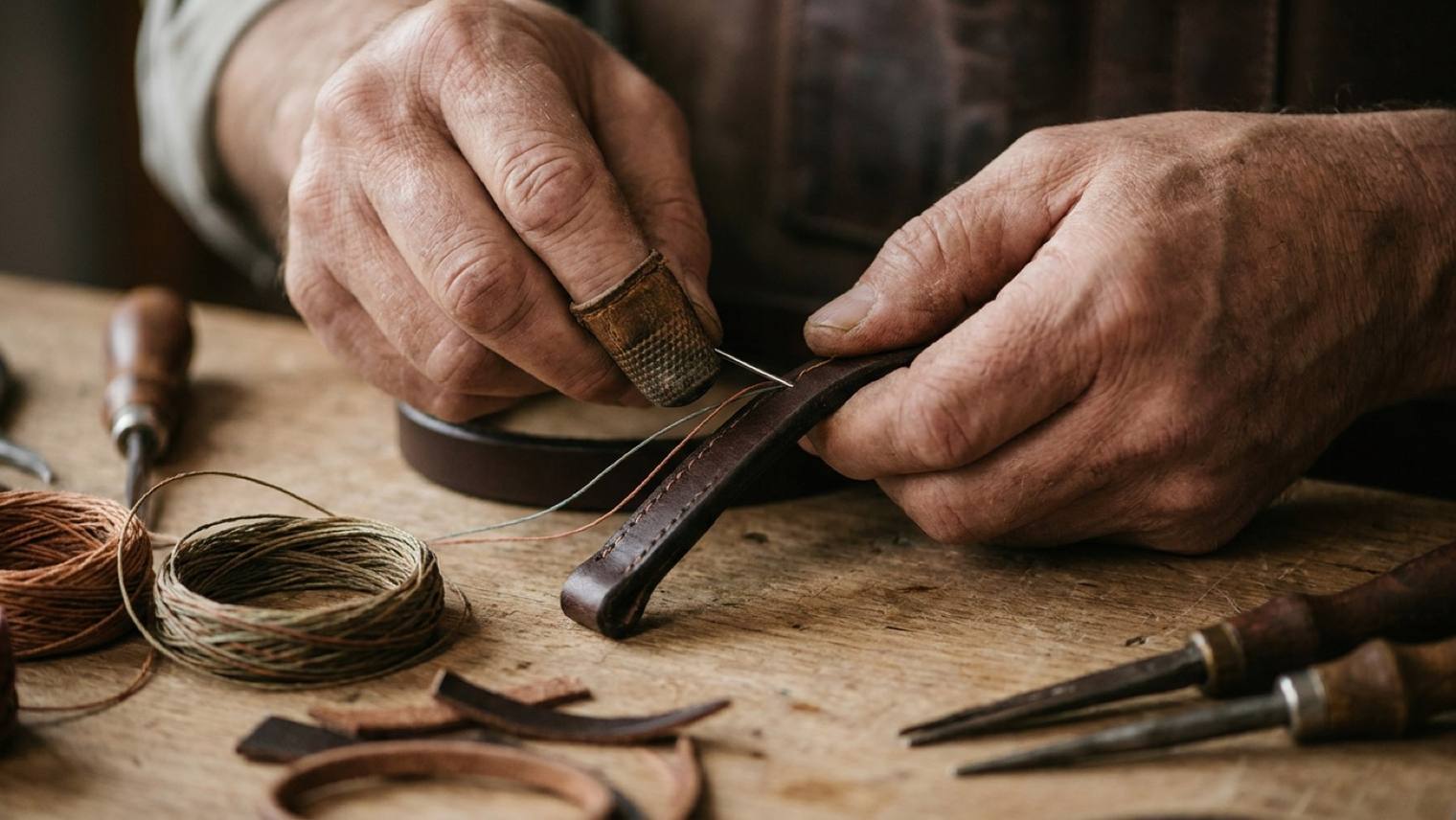
The design is first traced, then stitched: by hand, with waxed linen or silk thread, for lettering and fine motifs; on an embroidery machine set up for leather, with a cutting-point needle, for larger motifs and small runs. In both cases the stitch density is calculated so as not to perforate the leather like a dotted line, which would cut it at the first pull.
The finish matters as much as the stitch: threads are secured on the back, the piece is lined so nothing rubs against the horse, and the edges are dyed and burnished as on any piece of saddlery.
What can be embroidered
- browbands and headpieces, with a name, a monogram or a motif;
- leather headcollars, on the noseband or cheekpiece plate, the classic place for initials;
- breastplates and cruppers for driving, in a house’s colours;
- bags, cases and leather accessories that several of our workshops also make.
Saddle pads and fly bonnets, in fabric, can be embroidered too, with other techniques. Sapristouch’s customisable bonnets are one example. On leather, Perez Sellerie’s customisable KilPenn is ordered with its own design, and the bridlework section gathers the browbands and headpieces of our workshops.
Ordering an embroidered piece
Embroidery takes preparation. The workshop needs the exact text, with its capitals and accents, the desired font or style, the thread colours, and the space available on the piece: a pony browband does not take the same number of letters as a draught horse’s. An embroidered piece generally needs one to three weeks more than a plain one. Our article preparing an order with an artisan saddler lists what to provide, and for choosing the headcollar itself, leather headcollars: choosing the size and finishes.
Caring for embroidery
Thread tolerates greasy products less well than leather. Clean the embroidered area with a damp sponge, without heavy soap, and apply balm around the embroidery rather than over it. Fraying embroidery can be restitched in the workshop as long as the leather beneath is intact.
From the workshops
Pieces related to this guide
Also worth reading