Horse coat colours: recognising the main distinctions
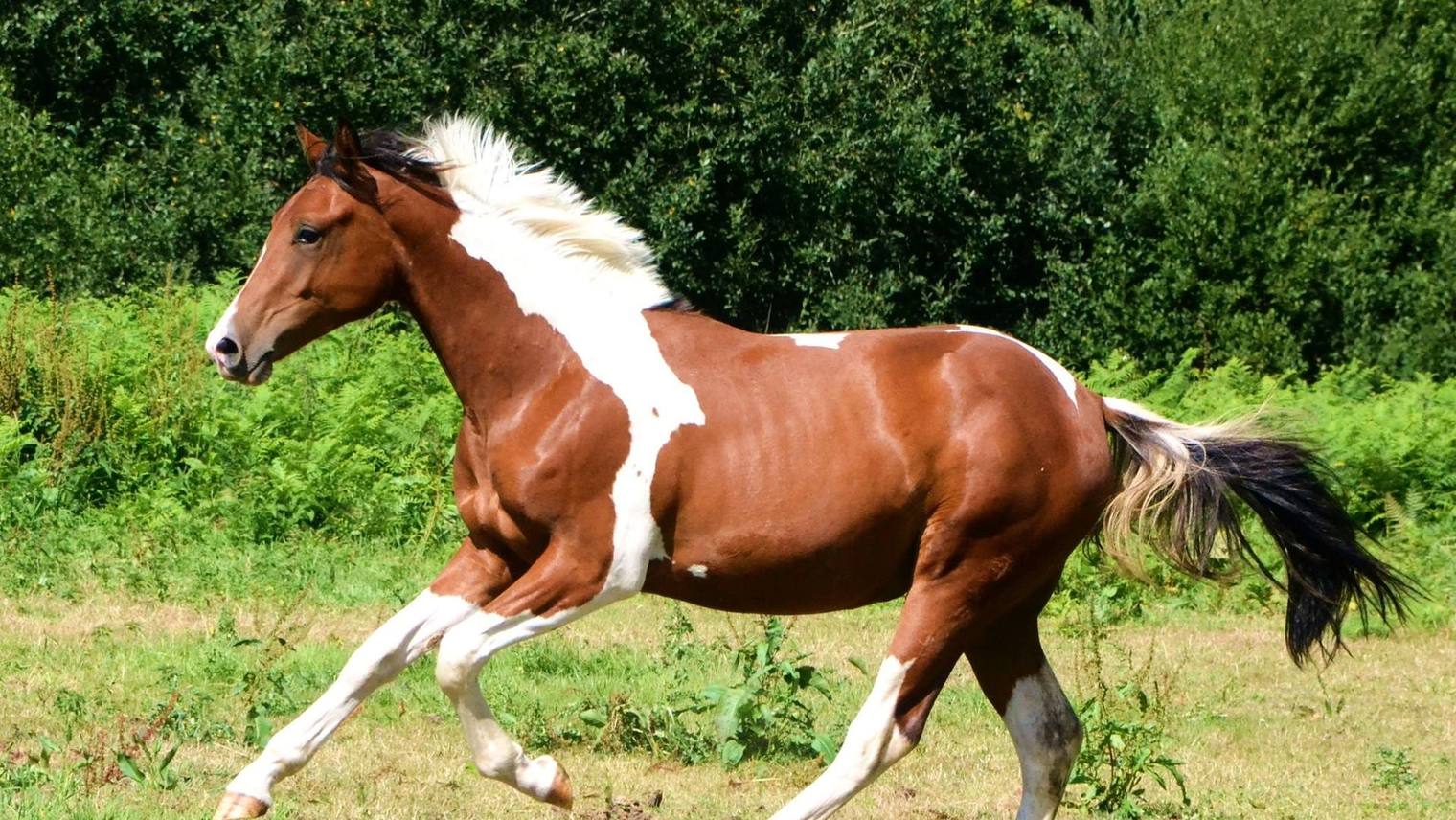
Calling a horse “brown” describes an impression, but may not identify its coat colour precisely. Look at the body, mane, tail and lower legs, then compare your observations with the horse’s documents. Sunlit photographs can exaggerate highlights and conceal details.
Three base colours
| Colour | Simple visual guide |
|---|---|
| Chestnut | Red to dark brown hair, without black mane, tail or points |
| Bay | Brown or reddish body with black mane, tail and lower legs, apart from white markings |
| Black | Black body hair, mane and tail, apart from white markings |
Base-colour genetics involve Extension and Agouti, among other considerations. A single “dominant black gene” is therefore not a sufficient explanation. UC Davis, coat-colour genetics.
Black: how to recognise it
A black horse has black hair, black mane and tail, black skin and dark eyes; white markings on the head and legs are still possible. IFCE, the black family. Look at the horse in the shade, at the muzzle, flanks, belly and inside of the thighs: that is where the colour reads best.
That is also where black parts from dark bay. A bay, however dark, keeps tan or reddish hair on the body, visible on the muzzle and flanks, with black mane, tail and lower legs. IFCE, the bay family. Pangaré black, on the other hand, belongs to the black family: the body is black, with tan hair confined to the nostrils, flanks, elbows, belly and inner thighs. In a photograph taken in full sun these shades vanish, which is where most mistakes are made.
Sun makes it harder still. The IFCE notes that a black coat can turn reddish in the sun. In summer, on a horse living out, the hair tips fade to a rusty brown and the horse looks dark bay. Look at the hair roots, the head and the sheltered areas, and see the horse again after it sheds: the new coat comes back black. A sun-faded black and a true dark bay can be told apart this way, without a test.
| What you see | What it may be | What to look at |
|---|---|---|
| Black body, black muzzle and flanks | Black | The horse in the shade, the hair roots |
| Black body, tan hair on the muzzle, flanks and belly | Pangaré black | Mane, tail and lower legs stay black |
| Very dark brown body with reddish glints, black mane and legs | Dark bay | Up close, the body hair is tan or reddish, not black |
| “Black” in winter, rusty brown in summer | Sun-faded black | The new coat after shedding, the sheltered areas |
Genetically, black needs two things: at least one E allele of the Extension gene, which allows black pigment to be produced, and two copies of the recessive a allele of the Agouti gene, which lets that pigment spread over the whole body instead of being restricted to the points. A bay carries E and at least one A; a chestnut is e/e and produces only red pigment whatever its Agouti genotype. UC Davis, coat-colour genetics. For a breeding plan, testing both genes gives the answer, not the parents’ apparent colour.
Finally, black is a coat colour, not a breed. Some breeds have made it their colour: the Mérens, a small horse from the Ariège Pyrenees, is described by its breeders as entirely black, and the Friesian is another familiar example. Pyrenean local breeds network, the Mérens horse. But black horses occur in many other breeds, and an advertisement for a “black horse” describes a colour and nothing more: the breed is in the identification papers, and neither temperament nor ability follows from either. To choose a horse, see our guide on preparing visits and trials.
Buckskin and palomino: look at the mane and tail
In the classic cream-dilution case, one copy of the cream allele on a bay base produces buckskin, commonly called isabelle in French. The body lightens while the points remain dark. On a chestnut base, it produces palomino: a golden coat with light mane and tail. Two copies produce other colours, including perlino or cremello depending on the base. UC Davis, cream dilution.
Dun results from a different mechanism. UC Davis, dun. For precise identification or a breeding project, ask the laboratory which test answers your question; visual similarity alone does not establish a genotype.
Grey changes with age
Greying is progressive loss of pigment in the hair and can act on different base colours. A horse may become almost white, at a variable rate. An older photograph showing a darker coat is therefore not necessarily inconsistent. UC Davis, grey.
“Dappled” describes an appearance. It does not establish a precise age. Avoid identifying white, grey or grullo from one overexposed image.
Describe what you can support
For a sales listing or a question to a professional, take side-on photographs and additional views of the head, mane, tail and legs. Record the date and keep files without colour filters. State any uncertainty instead of changing an official description yourself.
Colour is descriptive information, not an assessment of suitability. When choosing a horse, examine its actual training, history and compatibility with your riding level. When buying equipment, take measurements and check fit; black, grey or golden coats do not require a particular size.
You can then choose colour combinations to suit your taste. Cut, dimensions and intended use remain the first questions to resolve.
From the workshops
Pieces related to this guide
Also worth reading