Dressage: understand arena figures, tempo and impulsion
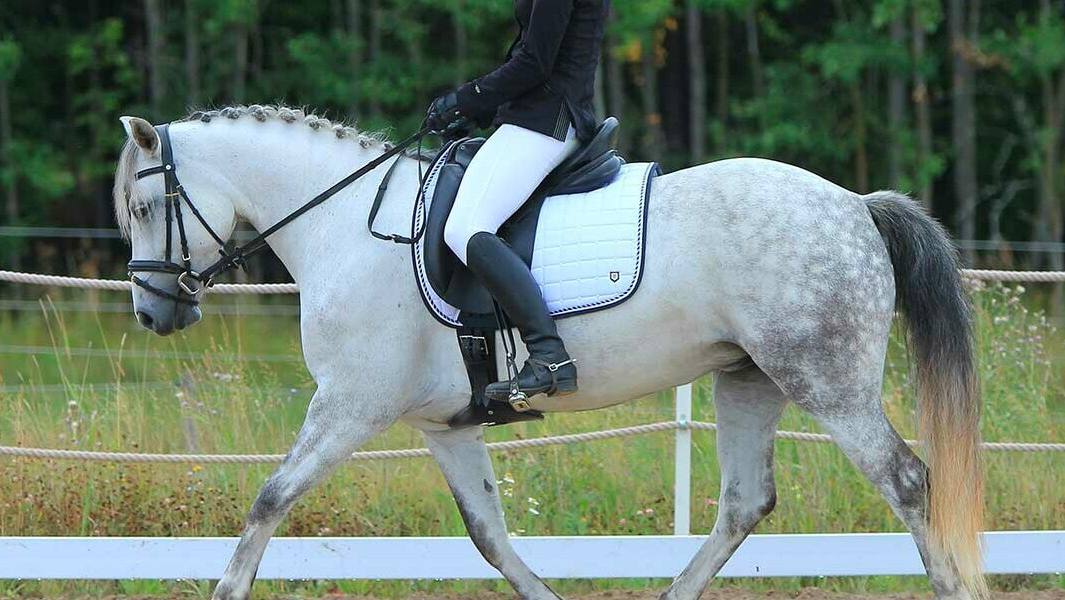
Dressage can refer to a horse’s schooling and to a competition discipline. In competition, the partnership performs a test: a sequence of movements set by a programme. For a learner, understanding lesson vocabulary helps establish what the work is meant to improve.
Start with the requested route
An arena figure describes a path. For a circle or volte, ask for the required diameter and where to rejoin the track. For a diagonal, identify start and end points. Ask for a drawing of a half-volte or serpentine if the name alone is unclear.
Difficulty is not determined by the drawn shape alone: gait, dimensions, horse and training aim also matter. An instructor may enlarge a turn or simplify a sequence to keep the work appropriate.
The volte: track, bend and exit
A volte is a small circle. Dressage rules define it as a circle of 6, 8 or 10 metres in diameter; anything larger is called a circle. Equestrian Australia dressage rules, based on the FEI rules. In a test it starts at a letter and ends exactly where it began, back on the track. In training it is also ridden in a corner, to prepare the corner or to check the bend.
The difference from a 20-metre circle is not only the shape. The smaller the circle, the more the horse must bend and carry weight on the hind legs to keep its balance and tempo. The diameter is therefore chosen with the instructor, for that horse and its level of training: a 6-metre volte has no place in the work of a young or lightly trained horse, and a novice rider first learns to ride an even 10-metre volte at walk, then at trot.
The aids are those of the circle, as described by the French equestrian institute IFCE in its note on the aids of the circle. The inside leg, at the girth, maintains activity and bend with brief actions rather than constant pressure. The outside rein controls the outside shoulder and receives the push of the inside hind leg; it softens when the horse is bent and balanced. The inside rein asks for flexion without pulling, and the outside leg, slightly back, keeps the quarters from swinging out. The rider’s eyes lead the line.
| What happens | What to check |
|---|---|
| The horse falls in, the inside shoulder drops into the circle | Is the outside rein holding the shoulder? Is the inside leg acting, or is the rider pulling the inside rein? |
| The circle becomes an egg or closes up | Were the four points of the circle picked out before starting? Does the exit happen at the entry point? |
| The neck bends but the body stays straight and the quarters swing out | Is flexion asked with too much inside rein? Is the outside leg keeping the quarters? |
| The tempo slows or rushes inside the volte | Is the diameter too small for this horse today? Should it be enlarged before trying again? |
In the French Galops programme, the volte is one of the standard figures from Galop 2, with the circle, the diagonal and the turn across the school: draw and name it, then ride it at walk and trot. The half-volte and reversed half-volte come at Galop 3, and 10-metre circles from Galop 5. FFE, official Galops 1 to 7 programme. A half-volte is a half circle followed by a diagonal line back to the track, changing the rein; the reversed half-volte starts with the diagonal and ends with the half circle. A figure of eight is two circles or two voltes that touch: the change of bend is prepared before the meeting point, over one or two straight strides.
Separate speed, tempo and impulsion
The French equestrian institute IFCE provides guidance on observing a working horse. Speed describes distance covered over time; tempo is the frequency of strides. Impulsion concerns the quality of energy in movement and does not simply mean travelling faster.
When asked for more impulsion, ask what the instructor wants to see in that situation. Accelerating without understanding the aim may produce a different response. Slowing down does not automatically create more impulsion either.
Observe one criterion at a time
Agree one indicator for the next attempt: meeting a specific point, maintaining a regular tempo or preparing a transition at the stated location. A clear instruction makes comparison between attempts useful.
| After the movement | Question to ask |
|---|---|
| The route changed shape | Where did I lose my reference point? |
| The tempo changed | Did it begin before or during the figure? |
| The transition was late | When should I have prepared the request? |
| The horse showed unfamiliar discomfort | Should work stop while the cause is assessed? |
Avoid trying to apply many corrections simultaneously. Ask for unfamiliar terms to be explained and keep one usable instruction for the session.
Prepare a competition test
Obtain the exact test sheet from the governing body and check its edition. Identify the sequence, arena letters, movements and listed coefficients. For France, test protocols and technical conditions are covered in the FFE dressage documents; check for updates before the event.
Afterwards, review comments with your instructor and choose a priority. A mark describes a performance in a particular setting; it does not replace the horse’s ongoing management or the rider’s training plan.
From the workshops
Pieces related to this guide
Also worth reading